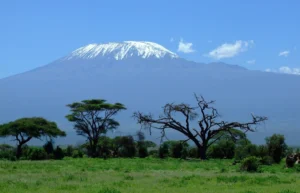
Day after day of cloudless skies, Tarangire National Park, Home of the baobab trees….
The fierce sun sucks the moisture from the landscape, baking the earth a dusty red, the withered grass as brittle as straw. The Tarangire River has shrivelled to a shadow of its wet season self. But it is choked with wildlife. Thirsty nomads have wandered hundreds of parched kilometres knowing that here, always, there is water.
Herds of up to 300 elephants scratch the dry river bed for underground streams, while migratory wildebeest, zebra, buffalo, impala, gazelle, hartebeest and eland crowd the shrinking lagoons. It’s the greatest concentration of wildlife outside the Serengeti ecosystem – a smorgasbord for predators – and the one place in Tanzania where dry-country antelope such as the stately fringe-eared oryx and peculiar long-necked gerenuk are regularly observed.
During the rainy season, the seasonal visitors scatter over a 20,000 sq km (12,500 sq miles) range until they exhaust the green plains and the river calls once more. But Tarangire’s mobs of elephants are easily encountered, wet or dry.
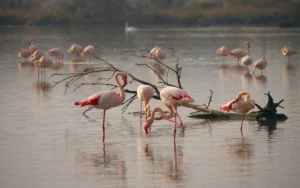
The swamps, tinged green year-round, are the focus for 550 bird varieties, the most breeding species in one habitat anywhere in the world.
On drier ground you find the Kori bustard, the heaviest flying bird; the stocking-thighed ostrich, the world’s largest bird; and small parties of ground hornbills blustering like turkeys.
More ardent bird-lovers might keep an eye open for screeching flocks of the dazzlingly colourful yellow-collared lovebird, and the somewhat drabber rufous-tailed weaver and ashy starling – all endemic to the dry savannah of north-central Tanzania.
Disused termite mounds are often frequented by colonies of the endearing dwarf mongoose, and pairs of red-and-yellow barbet, which draw attention to themselves by their loud, clockwork-like duetting.
Tarangire’s pythons climb trees, as do its lions and leopards, lounging in the branches where the fruit of the sausage tree disguises the twitch of a tail.
About Tarangire National Park
Size: 2850 sq km (1,096 sq miles).
Location: 118 km (75 miles) southwest of Arusha.
Getting there
Easy drive from Arusha or Lake Manyara following a surfaced road to within 7km (four miles) of the main entrance gate; can continue on to Ngorongoro Crater and the Serengeti.
Charter flights from Arusha and the Serengeti.
What to do
Guided walking safaris.
Day trips to Maasai and Barabaig villages, as well as to the hundreds of ancient rock paintings in the vicinity of Kolo on the Dodoma Road.
When to go
Year round but dry season (June – September) for sheer numbers of animals.